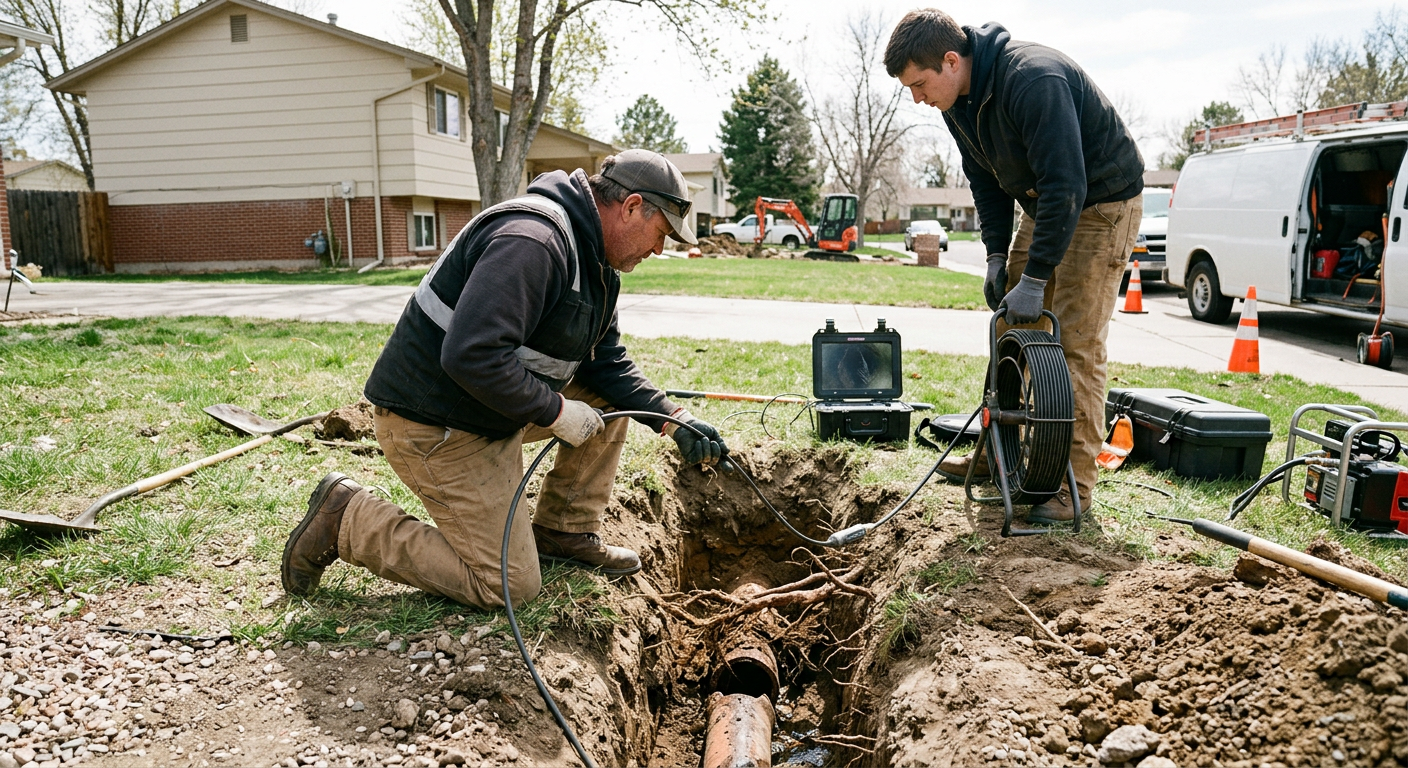
Sewer line root intrusion in Aurora typically announces itself through slow draining across multiple low-lying fixtures, rhythmic gurgling sounds in toilets, foul odors near basement floor drains, and isolated patches of lush grass over the sewer lateral path. These symptoms occur when tree roots exploit hairline pipe joint gaps to access underground moisture and nutrients.
Key takeaways
- Simultaneous slow drainage across lowest-level plumbing fixtures is the most reliable early symptom of root invasion.
- Aurora's expansive clay soils shift seasonally, pulling pipe joints apart and creating entry points for opportunistic root systems.
- Mechanical snaking provides immediate emergency flow relief, but high-pressure water scouring or structural repair is required to prevent rapid regrowth.
- Video camera diagnostics are essential to differentiate between simple organic clogs and structural lateral fractures caused by root expansion.
- Vitrified clay and older cast iron laterals face the highest risk of root penetration along Front Range residential corridors.
Managing sewer line root intrusion aurora homeowners experience requires catching sub-surface pipe breaches before raw sewage backs up into living spaces. When underground lateral pipes crack or shift, mature root systems from neighborhood trees naturally seek out the steady moisture, warmth, and nutrient flow traveling through residential waste lines. Recognizing the subtle warning signs inside your home allows you to take action before an emergency overflow damages finished basements or foundation slabs. For comprehensive maintenance guidance and seasonal drainage tips, visit our drainage and sewer blog archive.
What Observable Plumbing Clues Reveal Root Infiltration Before a Total Lateral Stoppage?
The earliest warning signs of underground root penetration appear as subtle hydraulic slowdowns rather than sudden, catastrophic pipe blockages. In Aurora properties, a single clogged sink or isolated toilet trap generally points to a localized fixture problem, but when multiple drains on the lowest level of the home begin draining slowly at the same time, the main underground lateral is almost always restricted. Root masses act like natural filters inside the line, catching toilet tissue, hair, and kitchen fats that would otherwise wash freely into the municipal main.
Homeowners searching online for fast drain cleaning near me often discover that standard plunging provides only brief, fleeting relief. When roots partially bridge a sewer channel, water trickles past the obstruction slowly, creating an air vacuum in the drainage stack that pulls water out of nearby P-traps. This vacuum effect produces distinct gurgling sounds in downstairs bathtubs or toilets whenever a washing machine drains or an upstairs shower runs.
Why Front Range Shade Trees Exploit Residential Waste Lines for Moisture
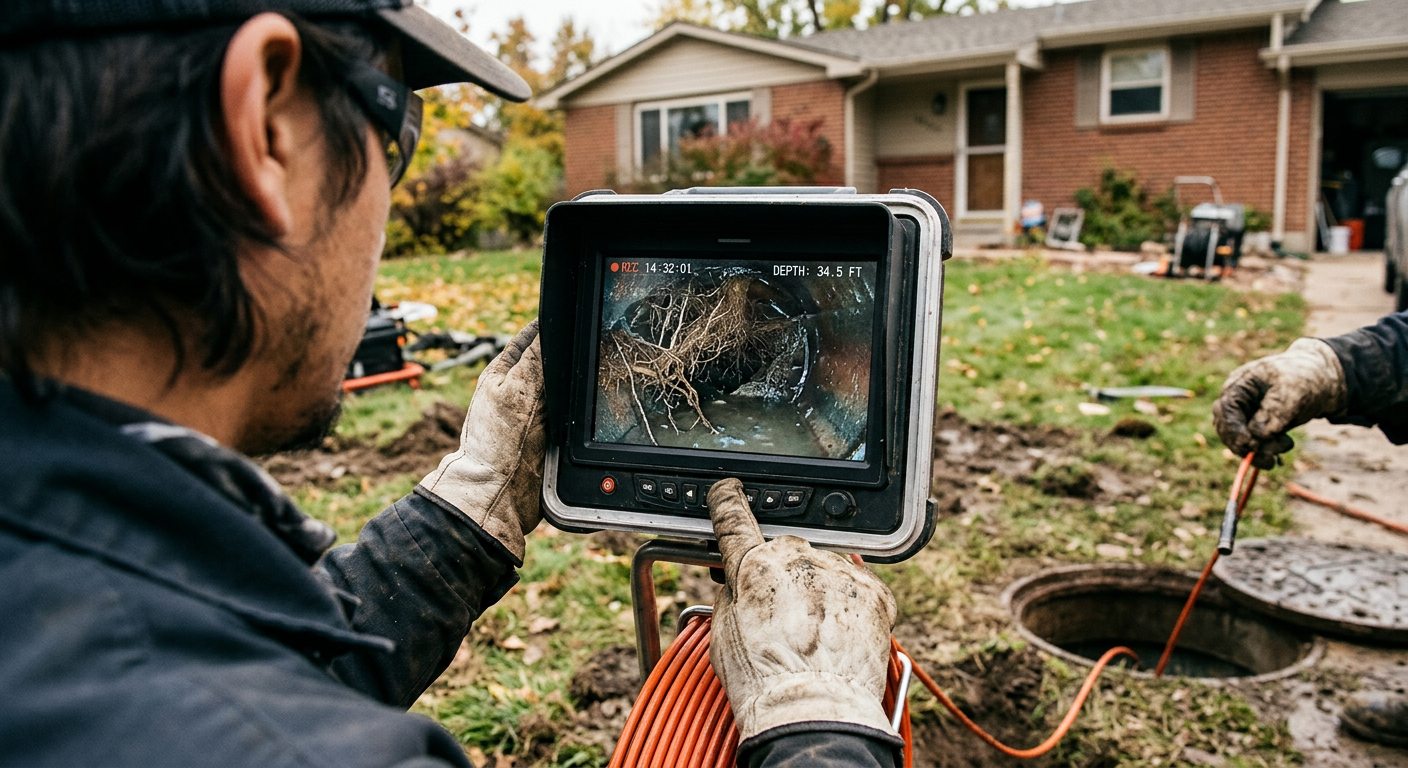
Tree root systems in the semi-arid Aurora climate actively track microscopic vapor trails escaping from aging pipe joints to survive dry summer months and freezing winters. Fast-growing shade trees common to older Aurora neighborhoods—such as cottonwoods, Siberian elms, silver maples, and willows—develop extensive lateral root zones that extend two to three times the radius of the tree canopy. These roots do not forcefully punch through solid pipe walls initially; instead, microscopic root hairs slip through mortar joints, rubber couplings, or hairline fractures where warm vapor leaks into surrounding earth.
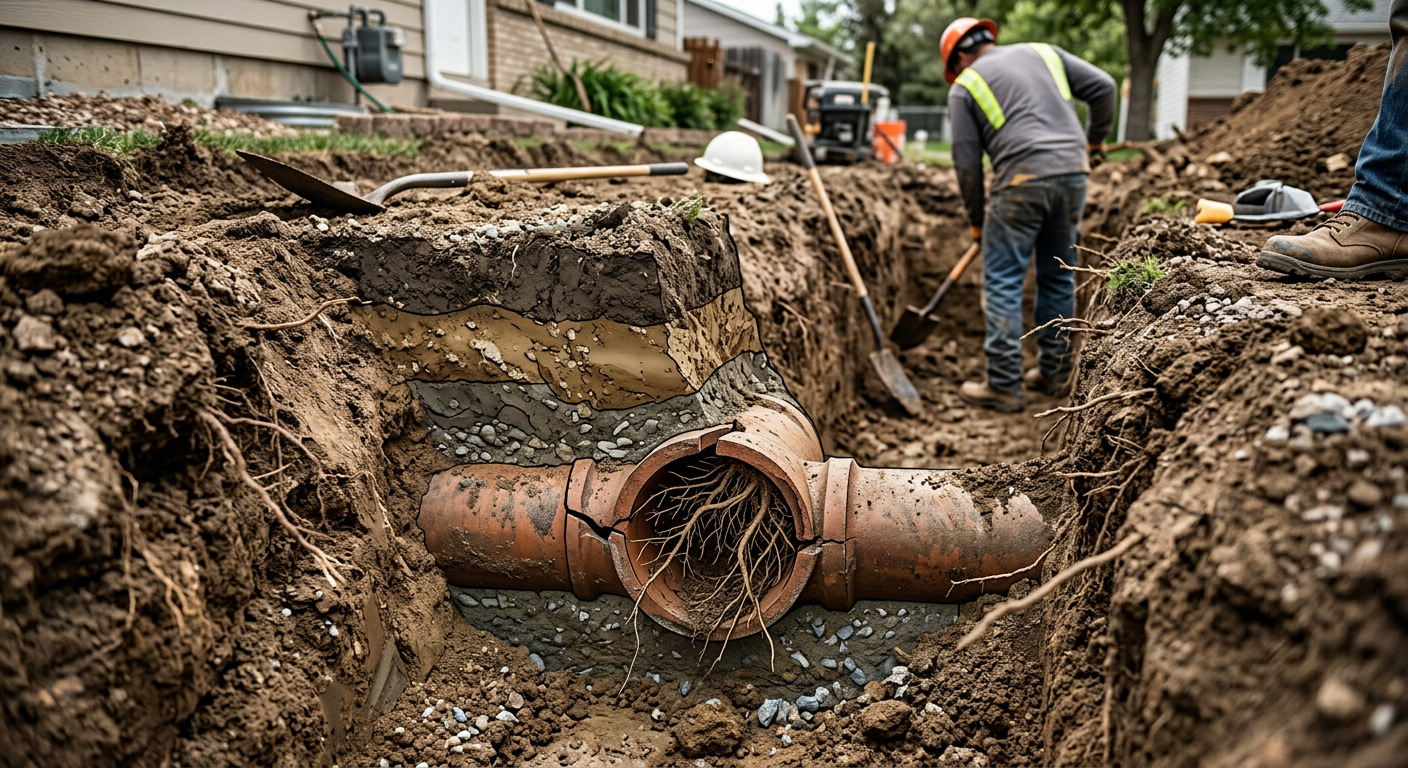
Once inside the host pipe, the root hair is exposed to continuous water, oxygen, and organic nutrients. It rapidly expands into dense, fibrous curtains that fill the interior pipe bore, creating an escalating root intrusion sewer problem. As the internal root mass thickens, it exerts radial pressure outward against the pipe hub, enlarging the initial crack and eventually fracturing the host pipe.
Interior Household Warning Signs Created by Underground Root Masses
Internal household symptoms follow a predictable progression as tree root masses grow from fine feeder tendrils into dense woody obstructions. Observing how your plumbing fixtures behave during high-water tasks gives you a clear indication of how severely the lateral pipe is compromised.
Gurgling Sounds and Multiple Sluggish Drains on Ground Floors
Persistent gurgling noises from basement toilets or utility sinks indicate that air is trapped behind an underground root obstruction. When waste water hits a dense root mass, it forms a partial hydraulic dam that forces displaced sewer gas backward up the venting system, burping through the water seals of ground-level traps. If flushing a main-floor toilet causes the adjacent bathtub drain to bubble or rise, the lateral line is operating at severely diminished capacity.
Wastewater Seepage Around Basement Floor Waste Receptors
Wastewater pooling around basement floor drains during laundry or shower cycles signals an imminent main line backup that requires prompt professional evaluation. Because basement floor drains sit at the lowest structural elevation in the plumbing system, restricted water follows the path of least resistance and rises through these drains first. Technicians evaluate whether high-velocity water scrubbing or cabling is appropriate for the line; you can review clearing methods in our comparison of hydro jetting versus snaking a main drain.
How Colorado Bentonite Soil Movement Facilitates Sewer Line Root Intrusion in Aurora
Expansive bentonite clay soils across Aurora expand when saturated and shrink during dry spells, applying immense physical shear stress to buried sewer laterals. This continuous ground movement causes rigid sewer pipes to shift, creating offset joints where adjacent pipe sections separate by fractions of an inch. Even a separation of one-eighth of an inch provides ample room for tree roots to enter and establish dense root networks.
In established subdivisions across central and northern Aurora, clay soils combined with mature landscaping make underground pipes especially vulnerable. When heavy spring precipitation saturates the surface, topsoil swells while deeper subsoil layers remain dry, placing vertical stress on the sewer lateral and pulling hub-and-spigot joints apart. Once tree roots penetrate these loose connections, root growth accelerates joint separation, creating an entry point for surrounding clay soil that leads to channel sinkholes.
Field Video Diagnostics: Pinpointing Root Clusters and Pipe Joint Displacement
Professional sewer camera diagnostics allow technicians to pinpoint the exact depth, distance, and severity of root masses without disturbing finished landscapes. A specialized self-leveling fiber-optic camera head is inserted through an accessible exterior cleanout or basement cleanout tee, transmitting high-definition video footage to an above-ground monitor. This allows the technician to inspect every pipe hub, identify cracked bells, and measure the percentage of diameter lost to root infiltration.
Conducting a thorough sewer scope before buying a house protects prospective homebuyers in the Denver metro area from inheriting thousands of dollars in hidden lateral damage. In existing properties, camera inspections also reveal whether neighboring exterior lines—such as a sump pump discharge line or an exterior storm drain installation—have been compromised by aggressive surface tree roots growing near the foundation perimeter.
Comparing Pipe Material Vulnerability to Root Blockages and Fractures
Different sewer lateral materials display varying levels of resistance to root penetration based on their joint design, wall rigidity, and structural lifespan. Vitrified clay pipes installed throughout older Front Range neighborhoods are the most vulnerable due to their short four-foot segmented sections and porous cement-mortar joints.
| Pipe Material | Typical Era in Aurora | Root Vulnerability Level | Primary Entry Mechanism | Recommended Remediation Strategy |
|---|---|---|---|---|
| Vitrified Clay Tile | 1950s – 1970s | Severe | Mortar joint degradation and offset pipe bells | Hydro jetting, CIPP lining, or full pipe replacement |
| Cast Iron | 1960s – 1980s | Moderate to High | Corrosion pitting, channel scale, and failed lead-oakum joints | Mechanical descaling followed by trenchless epoxy lining |
| Orangeburg (Bituminized Fiber) | 1950s – 1960s | Extreme | Wall delamination, pipe flattening, and fiber punctures | Immediate structural replacement or pipe bursting |
| Schedule 40 PVC / ABS | 1980s – Present | Very Low | Improper solvent welds or physical shear breaks from soil movement | Spot excavation repair or localized mechanical clearing |
| High-Density Polyethylene (HDPE) | 2000s – Present | Extremely Low | Fused seamless joints eliminate penetration points completely | Routine periodic preventative inspection |
Long-Term Pipe Restoration Options When Root Infiltration Recurs
When root intrusions recur frequently despite mechanical clearing, homeowners must weigh periodic maintenance costs against permanent structural pipe rehabilitation. While mechanical blades can temporarily cut through root curtains, the roots will quickly push back through the unsealed opening. If the host pipe retains structural roundness without severe ground dips, modern no-dig rehabilitation can seal off root entry points permanently.
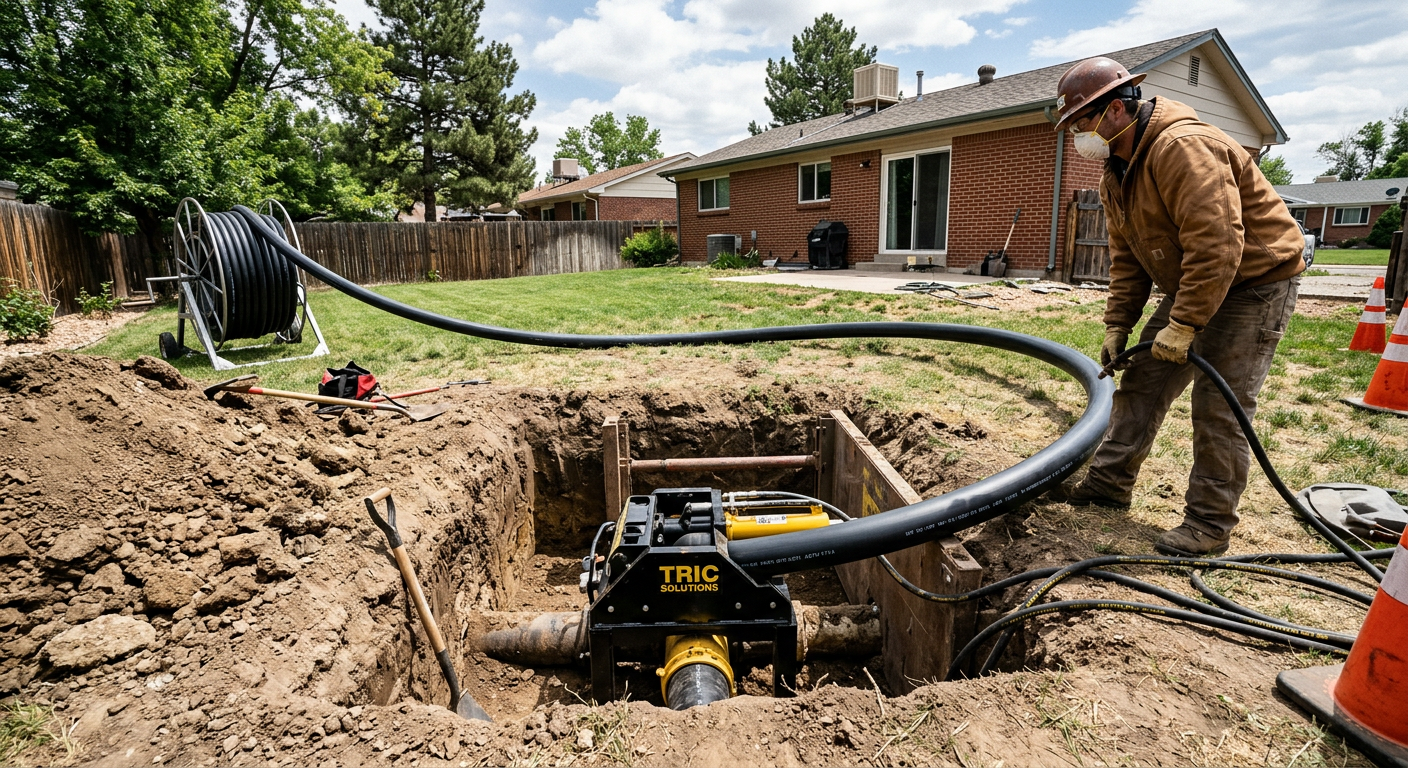
For lateral lines with intact structural slope, epoxy-cured lining creates a seamless, jointless barrier that stops roots from detecting moisture leaks. To understand when no-dig methodologies are appropriate for residential lots, explore our detailed analysis of trenchless sewer repair options across Denver. When clay lines have suffered extensive fractures or channel collapses, complete clay sewer pipe replacement using hydraulic pipe bursting or open excavation provides a permanent, root-proof drainage pathway.
Practical Response Protocol for Suspected Sewer Line Root Intrusion in Aurora
Taking calculated diagnostic steps at the first sign of lateral slowdown prevents costly basement contamination and structural pipe failure. If your home exhibits gurgling drains, foul sewer odors, or slow downstairs drainage, follow this practical field checklist to protect your plumbing system:
- Halt High-Volume Water Use: Immediately discontinue running dishwashers, washing machines, and multi-fixture showers to prevent overfilling the restricted lateral channel.
- Locate Main Cleanout Access: Identify your main sewer cleanout fitting, typically located in the basement near the foundation wall or outside near the front landscape bed.
- Schedule Video Lateral Diagnostic: Request an underground camera inspection to verify whether the restriction is caused by fine root tendrils, heavy root masses, or a fractured pipe section.
- Select Targeted Clearing Method: Utilize mechanical blade cabling for immediate emergency flow relief or high-pressure hydro scouring to clear the entire interior pipe circumference.
- Formulate a Permanent Repair Plan: If significant joint offset, wall collapse, or severe recurring growth is present, evaluate cured-in-place lining or seamless HDPE replacement options.
Understanding how seasonal ground movement and thirsty Front Range tree species affect underground plumbing helps you protect your home against severe lateral failures. Addressing sewer line root intrusion aurora issues early ensures that your residential drainage network flows reliably throughout every season.
Where we work
Frequently asked questions
- Can chemical root killers permanently eliminate root growth in sewer lines?
- Chemical root treatments can temporarily stunt fine feeder roots inside a lateral pipe, but they do not eliminate the structural defect or joint separation where roots originally entered. Over time, external root systems continue to expand against the pipe exterior, requiring mechanical clearing, jetting, or physical lateral rehabilitation.
- How quickly do tree roots regrow inside an Aurora sewer pipe after clearing?
- In the Denver metro area, aggressive tree species like cottonwoods, silver maples, and willows can send feeder roots back through unsealed pipe joints within six to twelve months after mechanical cutting. Periodic video inspections and high-pressure scouring help monitor and control regrowth intervals.
- Will homeowners insurance cover sewer repairs caused by root intrusion?
- Standard homeowners policies generally exclude underground pipe deterioration and root infiltration, classifying them as ongoing maintenance issues. However, optional service line riders or sewer backup endorsements may cover interior water damage or excavation costs depending on the specific policy terms.
- Why does running a washing machine trigger backups before other fixtures?
- Washing machines discharge a high volume of water under pressure over a short window—often 20 to 30 gallons in a few minutes. When tree roots restrict the main line diameter down to an inch or less, the lateral cannot accept that rapid surge, forcing wastewater upward through the lowest available opening, typically a basement floor drain.
Real calls behind this advice
“We recently moved into our house and decided to have all our drains cleaned. On-Call Rooter cleaned our sink, shower, and kitchen drains, performed a sewer line scope and inspection, and rootered our main sewer line. Everything is flowing great now. Highly recommend.”
Kass M
Whole-home drain clean and sewer scope · 3 months ago
“Feras was right on time and did a thorough job scoping my sewer line! He was very patient explaining the process and why my line backed up in the first place! I appreciated his efficiency and friendly demeanor! Thank You Feras!”
Linda Olson
Sewer line scoping · 2 months ago
Where Aurora Drainage Service works from
We dispatch across Aurora and the wider Denver metro, 24 hours a day. Call 720-779-4946 and a tech is usually rolling the same day.
5.0 (59 Google reviews) · Drainage service
Phone: (720) 779-4946
Hours: Open 24 hours
On-Call Rooter LLC drainage service on Google Maps — Aurora, CO